



Update: Paul Krugman: We're Now in a Depression
publication date: Nov 9, 2016
Update: On election night 2016 once if became clear that Donald Trump won the Presidential contest, Paul Krugman weighed in with his predictions in a column entitled, "The Economic Fallout" the highlights of which stated:
"It really does now look like President Donald J. Trump, and markets are plunging. When might we expect them to recover?
"It really does now look like President Donald J. Trump, and markets are plunging. When might we expect them to recover?
Frankly, I find it hard to care much, even though this is my specialty. The disaster for America and the world has so many aspects that the economic ramifications are way down my list of things to fear.
Still, I guess people want an answer: If the question is when markets will recover, a first-pass answer is never...
So we are very probably looking at a global recession, with no end in sight..."Update: About four and a half years ago, I wrote the column below evaluating the record of the New York Times' Paul Krugman. At that time, Krugman opined that we were entering another economic depression. In addition to explaining the enormous flaws in Krugman's analysis and thinking and why I was near certain he would be wrong, I also documented his terrible track record and extreme left ideology. Krugman was unhappy with Obama for the federal government not spending more on its largely failed stimulus program! He also felt that EU countries didn't have a spending problem!
Well, the verdict is in and Krugman not surprisingly has been proven wrong again. Global economies have largely enjoyed growth since 2010 the past two plus years and this has pushed global stock prices higher. Yes, there are challenges in Europe and some countries in the EU are in recession. And, yes the U.S. unemployment rate is too high. But, the U.S. is growing slowly and most emerging economies have enjoyed solid growth. So, no depression - no even close. And investors are showing more optimism about the EU now that those countries are cutting back on government spending - which is the opposite of what Krugman recommended.
All over the Internet are headlines and links to New York Time's columnist Paul Krugman's column, The Third Depression, in which he states:
"We are now, I fear, in the early stages of a third depression."
I have read many of Krugman's columns in the New York Times over the years. Most often, I would be sent his columns by a reader or a friend asking me what I thought of his economic commentary.
I often find that folks who are impressed with his columns or who agree with his point of view would quickly point out that Krugman is an economist. However, a surprising number of people don't realize that Krugman is an opinion columnist for the paper. In fact Krugman's column is entitled Conscience of a Liberal.

Before I analyze Krugman's "we are now in a depression" column, I'd like to cover some important background about him.
Krugman the Partisan Ideologue
If the title of Krugman's column isn't a big clue to his extraordinary liberal bias, there is a study of his columns to back it up done by Cary, N.C. researcher Ken Waight who operates the web site "Lying in Ponds." Here's how Waight describes his efforts to ferret out partisan columnists:
"Lying in Ponds is an attempt to encourage vigorous, independent commentary in the American punditocracy by quantifying and analyzing partisanship. Lying in Ponds tries to draw a fundamental distinction between ordinary party preference and excessive partisanship. The presence of an excessive partisan bias transforms journalism into advertising, too distorted and unreliable to be useful in any serious political debate. Political parties are a healthy, essential part of American democracy; excessive partisanship is not. The methods used here are an attempt to quantify only partisanship, and are not intended as a more general guide to the quality of a columnist. There are other important traits such as accuracy, relevance, fairness, civility and style, but Lying in Ponds makes no attempt to measure them.
Lying in Ponds currently tracks the Democratic and Republican biases of a selection of regular political columnists from various sources, including the New York Times, the Wall Street Journal's OpinionJournal, and the Washington Post."
Waight ranks the most partisan liberal and conservative columnists every year based upon an analysis of all of their columns and the number of positive and negative references each columnist makes to Democrats and Republicans. (In case you don't have your dictionary handy, Waight defines a partisan as "a firm adherent to a party, faction, cause, or person; especially: one exhibiting blind, prejudiced, and unreasoning allegiance.")
For the period 2002 through 2008, Paul Krugman was ranked the #1 most partisan Democratic columnist for seven consecutive years! (His Republican counterpart has most often been Anne Coulter). For 2009, Krugman dropped to the #4 most partisan Democratic columnist which Waight explains as follows:
"Lying in Ponds has strongly criticized Paul Krugman in the past for his amazingly one-sided commentary during the Bush years, so seeing him drop...is quite surprising. The change began last year during the primary season, when he strongly supported Hillary Clinton and John Edwards over Barack Obama after not taking a position in the 2004 Democratic primaries. His criticism of Mr. Obama didn't stop after the election - he has continued to strongly take issue with the administration's approaches to the economy and healthcare...Mr. Krugman's approach to Republicans has not changed. He has made only five total positive Republican references in six months, and three of the five were to Ronald Reagan and Lee Atwater. I've previously contended that it surely must be a sign of partisanship when a pundit's most frequent positive references to the opposite party are to dead people."
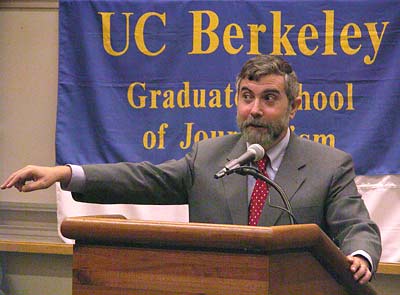
So, Krugman (photo below) continues to blast nearly all (living) Republicans but now is being somewhat critical of President Obama. The reason here is the same reason that Krugman is now saying that we're in a depression. Krugman wants even more government spending than what the Obama administration has been supporting. This may be hard for political moderates and conservatives to believe but Obama isn't nearly liberal enough for Krugman!
Krugman's Terrible Track Record
If his extreme liberal bias isn't enough, Krugman has a horrible track record when it comes to his economic predictions. Like Nouriel Roubini, year after year beginning in 2002, Krugman would say that we were still mired in a recession or about to re-enter one.
In a July 14, 2008 column just as the economy and stock market began a terrible slide, Krugman predicted that concerns about a possible collapse of the government sponsored lending agencies Fannie Mae and Freddie Mac were "overblown." Months later, both Fannie and Freddie required a massive government bailout that ballooned to more than $100 billion. Besides that huge blown call, Krugman also erroneously stated in that same column that Fannie and Freddie had no involvement with risky sub-prime loans.
Finally, Krugman has been a major proponent of federal government stimulus to create jobs lost in the recession. In a paper authored by economists Christina Romer and Jared Bernstein, who were hired by the Obama administration, they made the now infamous graph (see graph below or on page 5 of the linked report) in which they claimed that unemployment would rise no higher than 8 percent if the stimulus package were passed. As we all know now, the near $800 federal government stimulus package did pass and yet unemployment surpassed 10 percent and today is around 9.5 percent and still way above where it was supposed to be with the implementation of the government stimulus.
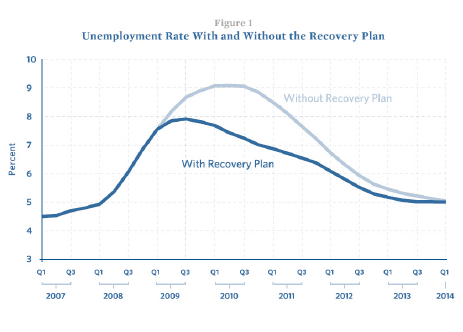
Despite these facts, Krugman has continued calling for even more federal government stimulus (spending) programs despite the first program's near complete failure to generate jobs. And, this brings us to Krugman's recent depression prediction.
Krugman's Depression Call
Now, let's return to Krugman's recent column in which he predicts that we're in a depression:
"We are now, I fear, in the early stages of a third depression...And this third depression will be primarily a failure of policy. Around the world - most recently at last weekend's deeply discouraging G-20 meeting - governments are obsessing about inflation when the real threat is deflation, preaching the need for belt-tightening when the real problem is inadequate spending."
I find the arrogance of Krugman's statement above mind boggling. What he is essentially saying here is that major governments around the world are all stupidly pursuing policies that will contribute to a depression. However, he Paul Krugman, knows the single answer that will avert depression.
Now, most folks who were paying attention during the economic downturn in 2008 and the financial crisis that garnered all sorts of government intervention and media attention, recall worries about another Great Depression. I wrote extensively about this in late 2008 and pointed out the excessive commentary and hype in much of the media and why it was off base.
So, what is Krugman's beef with current government actions?
"...you might have expected policy makers to realize that they haven't yet done enough to promote recovery. But no: over the last few months there has been a stunning resurgence of hard-money and balanced-budget orthodoxy.
As far as rhetoric is concerned, the revival of the old-time religion is most evident in Europe, where officials seem to be getting their talking points from the collected speeches of Herbert Hoover, up to and including the claim that raising taxes and cutting spending will actually expand the economy, by improving business confidence. As a practical matter, however, America isn't doing much better. The Fed seems aware of the deflationary risks - but what it proposes to do about these risks is, well, nothing. The Obama administration understands the dangers of premature fiscal austerity - but because Republicans and conservative Democrats in Congress won't authorize additional aid to state governments, that austerity is coming anyway, in the form of budget cuts at the state and local levels."
I'm not sure where Krugman is getting his news but I don't see most governments, and certainly not in Europe, anywhere near "balanced-budgets!" And, then Krugman absurdly blames political conservatives for espousing what he claims are misguided policies including raising taxes. Last time I checked, fiscal conservatives have no desire to raise taxes and in fact wish to lower taxes to stimulate the economy.
Krugman concludes:
"So I don't think this is really about Greece, or indeed about any realistic appreciation of the tradeoffs between deficits and jobs. It is, instead, the victory of an orthodoxy that has little to do with rational analysis, whose main tenet is that imposing suffering on other people is how you show leadership in tough times.
And who will pay the price for this triumph of orthodoxy? The answer is, tens of millions of unemployed workers, many of whom will go jobless for years, and some of whom will never work again."
So, there you have it. Krugman believes that those in power (who he seems to forget are the Democrats) wish to pursue what he sees as misguided policy because they maliciously wish to impose suffering on others! And, this, then will contribute to continued high unemployment according to Krugman.
With all due respect, Krugman doesn't fundamentally understand what leads to job creation and economic growth. This doesn't come from excessive government spending programs but from creating the right environment to foster business formation and growth. During strong economic times in any country, private companies, especially small businesses, not the government, are the economic engine that drives the economy.
Krugman and the New York Times
If Paul Krugman is so smart, why is he writing for a newspaper that's in a death spiral? It's no wonder Krugman thinks we're in a depression. You'd certainly think that from the NYT's stock performance over the past decade! The paper is in big trouble economically.

Copyright Eric Tyson, 2008 - 2023 all rights reserved.
Eric Tyson is the only best-selling personal finance author who has an extensive background as an hourly-based financial advisor and who does not accept speaking fees, endorsement deals or fees of any type from companies in the financial services industry or product or service providers recommended in his articles, books and his publications.